



So So Def Recordings was founded in 1993 and recognized as a pioneering Atlanta label responsible for jump-starting the careers of Bow Wow, Xscape, Da Brat, Bone Crusher, and 3LW. Dupri has also produced hit records for Mariah Carey, Usher, Ludacris, TLC, and Janet Jackson.
Dupri and his companies allege Sony engaged in “willful deceitful actions,” and his legal team came with the receipts.
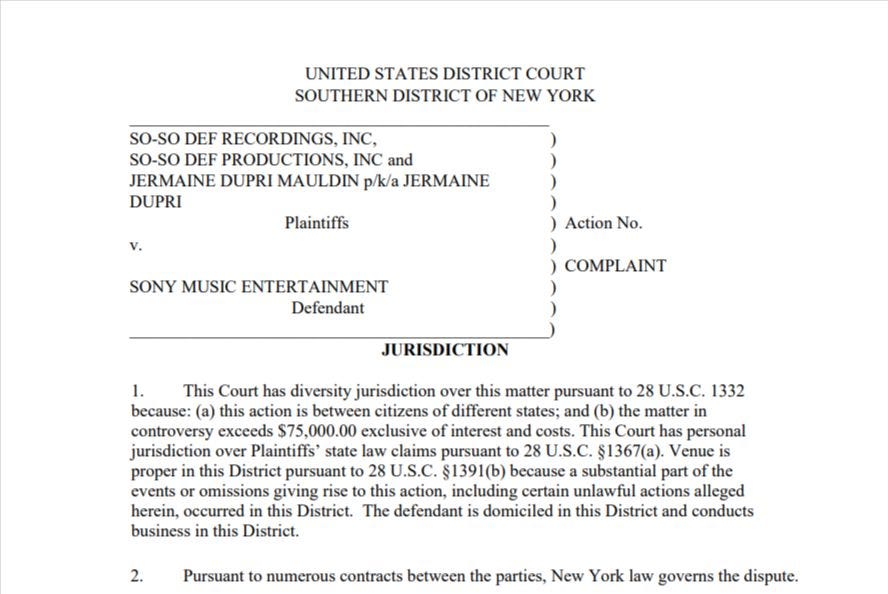
Jermaine Dupri lawsuit against Sony Music Entertainment court filing
In a conversation with Earn Your Leisure, JD talks about carrying Atlanta’s energy long before the city got its recognition and what it really meant to build So So Def from the ground up.
“I’m the n**a that’s out here that’s been fighting for this city before the face was in Atlanta… I’ve been here doing this and I feel like I really really carry the energy of Atlanta. Look how long it took Atlanta to actually become what Atlanta is today.”
— Jermaine Dupri
Jermaine Dupri’s Claims Against Sony Music
Before the numbers, understand how the money moves. A major label offers an artist somewhere between 10 and 15 royalty points off the standard retail list price of a record. Those points do not belong to the artist alone. Songwriters, managers, and producers take their cut from the same pool, which can leave the artist with five to seven. Look at the same money from the company’s side and the picture sharpens. Roughly 60% of royalty profits go straight to the label, and another 25% to 30% goes to distribution, which the major typically owns in-house. Fewer than 5% of artists who sign with a major will ever turn a profit. People overhype labels or write them off entirely, but it comes down to what that specific label brings to the table.
Here’s what the filing shows…
Kris Kross — The most alarming claim in the filing involves Kris Kross. Sony allegedly kept override royalties owed on Totally Krossed Out (1992) and Da Bomb (1993) in a separate accounting system that So So Def had no access to for over 20 years. Sony claims it was unaware. Evidence presented shows foreign digital earnings across 15 countries totaling over 12 million units with a royalty payout of just $3,327.01 for the group’s song “You Can’t Get With This” alone. In excess of $2.2 million is owed on Kris Kross alone.
Rest easy, Chris “Mac Daddy” Kelly.
What Recoupment Actually Means Recoupment is a loan. A label can front a million dollars across recording, marketing, video, and touring, and every one of those dollars comes back out of the artist’s royalties before the artist sees a check. Until the debt clears, the account sits unrecouped, and unrecouped is the label’s permission slip to hold the money. What makes it worse is that repaying the advance does not buy the artist out. The company still owns a royalty on every sale that comes after.
Xscape — Sony allegedly underreported producer royalties on Hummin’ Comin’ At ‘Cha (1993), with over $960,000 owed. For their first two albums to go platinum, the complaint claims the legendary group’s catalog is negative by over $1.5 million in So So Def’s Production Share account as of June 30, 2020. Between 2020 and 2024, that same account generated over $1 million in new earnings. Sony withheld those payments using the unrecouped balance as justification.
Get this… in 2021 Sony launched the Artists Forward Legacy Unrecouped Balance Program. The purpose of that program was to forgive old unrecouped balances, specifically any balances that originated 20 or more years ago, meaning Xscape’s albums were clearly well within the scope of that 20-year mark.
The balance should have been cleared, which ultimately would have triggered an obligation to report and pay nearly $1 million to So So Def, but Sony never paid.
Da Brat — Over $1 million in producer royalties allegedly withheld on Funkdafied (1994). Sony also underreported royalties on Da Brat’s second album Anuthatrantrum using incorrect royalty rates, though the full amount owed has not yet been determined.
Jagged Edge — The Jagged Era tells a similar story. Sony did not begin reporting previously unreported royalties on the album until 2023, and the amended statements reflect sales periods going back only as far as 2007, leaving a decade of earnings unaccounted for. The filing alleges Sony altered statements to conceal the full amount owed.

What Independence Actually Buys You
Independence is the closest thing this business has to freedom. In this business. Freedom means leverage.
Corporate labels have historically used independent Black music to feel the pulse of the public, then moved in with their own production and distribution to homogenize whatever was working. Owning your masters is how artists step out of that cycle.
Independent artists can earn 40% to 75% of their royalties. A major label artist earns 10% to 15%. In today’s music climate, ofc signing to a major label buys reach and capital. But it also buys a partner with a stake in everything. In the 2000s, labels introduced 360 deals, a model that can take anywhere from 25% to 30% of touring, nearly half of merchandise, and up to a quarter of endorsement money on top of record royalties. It is not often an easy decision to choose, especially when considering giving up control.

Did He Ever Get His Flowers?
The man deserves his flowers and then some. He gave us music that turned into a soundtrack for healing, for reflection, for moments that carry well for generations to come.
Through the lens of his catalog, the world experienced Atlanta. Kris Kross introduced a generation to the genre. Bow Wow gave the culture its youngest superstar. Xscape’s R&B sat in a lane all its own. Then came Usher’s Confessions and Mariah Carey’s The Emancipation of Mimi, both finished in his household.
He is not a rookie. He has three decades, a catalog valued over $200 million, and the money to hire people who read contracts for a living. It still took a lawsuit.
Whether the court sides with Dupri or not, the filing forces a conversation the industry has avoided for decades. Artists deserve to see the math. Not after a lawsuit. Not decades later.
Fluent in BLK is accepting pitches. If you’re interested, fill out the Write for Us form. We’re looking for writers with fresh perspectives on Black culture, music, entertainment, and the business behind it.
Sending photos with your pitch? Email editor@fluentinblk.com.
(Subject line) Pitch Pics: Why Women Are Choosing Spa Days Over Bottomless Brunch, Jane Doe
Industry context sourced from Christopher Vito, The Values of Independent Hip-Hop in the Post-Golden Era (Palgrave Macmillan, 2019).
The post Inside Jermaine Dupri’s $18 Million Lawsuit Against Sony Music Entertainment first appeared on FLUENT IN BLK.
