



Update, July 19 2026: Taylor Farms de México of Guanajuato, Mexico, released a public announcement on July 17, 2026, stating it is voluntarily removing all iceberg lettuce sourced from central Mexico from the U.S. market because it has the potential to be contaminated with Cyclospora.
Cyclosporiasis is an intestinal illness caused by the Cyclospora parasite. People become infected by eating food or drinking water that contains it. The parasite causes a major upset to the small intestine (bowel), leading to frequent, watery, and extremely uncomfortable stools.
If you have heard something about a stomach parasite going around and didn’t fully grasp what it was, or even if the words “explosive diarrhea” made you chuckle a bit, here is what is true. Cases are growing, and medical professionals are calling on the public to stay informed and take precautions.
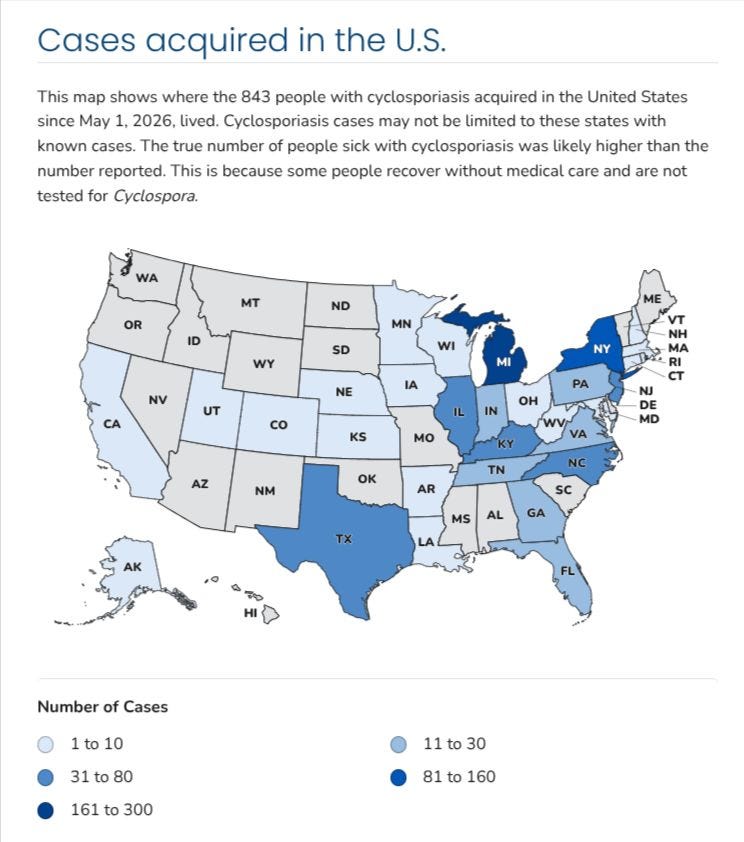
Health Crisis: Where Cyclosporiasis Is Hitting Hardest
Cases started showing up in May and spiked through June and July, and Southeast Michigan has been hit the hardest. The worst of it sits in Wayne, Oakland, Macomb, and Washtenaw counties, home to cities like Detroit, Dearborn, Troy, and Ann Arbor.
Even for a predominantly African American Detroit to descend from 82.2 % (586,573 residents) in 2010 to 75 % (478,586 residents) in 2024, the city remains one of the most heavily Black metros in the country, so this outbreak strikes a predominantly Black community.
The Michigan Department of Health and Human Services (MDHHS) reported 572 cases as of July 4, up from 170 on June 30. By July 10, that number had climbed to 1,562, with 44 people hospitalized.
Cases remain highest in Monroe, Lenawee, Washtenaw, Wayne, Shiawassee, Jackson, Oakland, and Livingston counties.
As of today, the CDC and MDHHS have not named a specific grower, supplier, or produce type as the source.

Who is at risk
People of all ages are at risk, and many who get infected are asymptomatic, meaning they carry the parasite but show no noticeable signs. Younger and older people, along with anyone who has a weakened immune system, are more vulnerable to serious illness.
When symptoms do show, they can also include loss of appetite and weight, cramping, bloating, increased gas, nausea, prolonged fatigue, body aches, and a low-grade fever with other flu-like signs. Vomiting is less common.
The time between exposure and getting sick is usually about one week; however, it can range from two days to two weeks or more.
What Recovery Looks Like
The good news is that no deaths have been reported.
If left untreated, the parasitic infection can last from a few days to more than a month (longer in patients with HIV), and it is common for symptoms to go away and then return.
Treatment
Trimethoprim-sulfamethoxazole, known as TMP-SMX, is the treatment of choice, an antibiotic sold under the brand names Bactrim and Septra and used for infections like UTIs, bronchitis, and traveler’s diarrhea.
Rest and plenty of fluids to stay hydrated are needed to round out the recovery phase.
If you or someone you know is experiencing symptoms, contact a health care provider and reach out to the nearest health department. Cyclospora testing is not part of a routine stool panel, so you have to ask for it by name.
How to lower your risk
A safer bet would be to prepare your own meals at home. And please, SCRUB your fruits and vegetables. A simple rinse will not cut it. The parasite hides in the spots a light rinse can miss.
Wash your hands with soap and water before and after handling food. Scrub firm produce like melons and cucumbers with a clean produce brush. Cut away bruised or damaged areas before eating. Sanitize your cutting boards, utensils, and surfaces, and refrigerate cut, peeled, or cooked produce as soon as you can.
The CDC and MDHHS tied these foods to past outbreaks: peas, lettuce and leafy greens, cilantro, basil, green onions, and raspberries.
Staying informed is how you stay ahead of this one, and a few small habits in your kitchen can protect you and everyone you feed.
Sources: CDC and the Michigan Department of Health and Human Services (MDHHS).
The post Cyclosporiasis Crisis Spreads Across the US as Infections Rise and Health Officials Urge Caution With Fresh Foods first appeared on FLUENT IN BLK.